

9:46:00 AM
Meteor News...North Texas Fireball OCT 16 2010
As I walked out of my garage at about 7:10 CDT this morning, I saw a very nice bolide in the eastern sky. It ran from about 35 degrees down to about 15 degrees altitude. It HAD to be very bright as it was quite prominent even right above the dawning sun (still below the horizon, but close). Anyone else see it? (more)...
1:09:00 AM
More News....Ireland Fireball

The fireball of 10th October 2010 as imaged by one of the Armagh Observatory cameras at 02:32 am.
Armagh Observatory received many telephone and internet reports from members of the public regarding sightings of a bright meteor or fireball which crossed over Northern Ireland in the early morning of Sunday, 10th October. (more)...
4:47:00 PM
ORIONID METEOR SHOWER
http://spaceweather.com/http://meteor.uwo.ca/Earth is entering a broad stream of debris from Halley's Comet, and this is causing the annual Orionid meteor shower. "The best time to look is during the hours before dawn on Thursday, Oct. 21st, and again on Friday, Oct 22nd," advises Bill Cooke of NASA's Meteoroid Environment Office. "Unfortunately, we have a bright Moon this year. Even so, I'd expect some bright Orionids to shine through the moonlight." An all-sky camera at the University of Western Ontario recorded this early Orionid fireball on Oct. 18th: (more)...

10:16:00 AM
Stargazers Can watch Orionid Meteor Shower, Debris From Halley's Comet
The 2010 Orionid meteor shower peaks during the day of October 21, 2010. For stargazers wanting to observe Orionid meteors, the best times will me the mornings of October 21 and October 22. (more)...
10:10:00 AM
Fireball streaks across Northern Ireland skies
The cause was actually a meteoroid, an orange-sized piece of a comet or asteroid, burning up over Northern Ireland early last Sunday. (more)...
10:18:00 AM
San Diego Fireball OCT 10 2010
METEOR SIGHTING CONFIRMED BY 2ND WITNESS; EXPERTS SEEKS MORE INFO TO LAUNCH RECOVERY EFFORT.
October 14, 2010 (San Diego’s East County) – Earlier this week we published an inquiry from a Deerhorn Valley/Jamul reader who believed she saw a large meteor possibly crashing to earth over East County on Monday night, October 10. (more)...10:48:00 PM
Latest El Paso All Sky Camera Detections

OCT 16 2010
01:14:00 UTC
ELP All Sky

OCT 14 2010
02:46:39 UTC
ELP All Sky

OCT 11 2010
11:56:32 UTC
ELP All Sky

OCT 11 2010
05:31:12 UTC
ELP All Sky

10:05:00 PM
Elusive Constellation Appears With Oct. Meteors
Camel Leopards and Comets Posted on Oct 08, 2010 02:43:20 PM | William Cooke
 Camelopardalis.
It's a strange-sounding name for a constellation, coming from the Greco-Roman word for giraffe, or "camel leopard". The October Camelopardalids are a collection of faint stars that have no mythology associated with them -- in fact, they didn't begin to appear on star charts until the 17th century.
Even experienced amateur astronomers are hard-pressed to find the constellation in the night sky. But in early October, it comes to prominence in the minds of meteor scientists as they wrestle with the mystery of this shower of meteors, which appears to radiate from the giraffe's innards.
The October Camelopardalids are not terribly spectacular, with only a handful of bright meteors seen on the night of Oct. 5. It may have been first noticed back in 1902, but definite confirmation had to wait until Oct. 2005, when meteor cameras videotaped 12 meteors belonging to the shower. Moving at a speed of 105,000 miles per hour, Camelopardalids ablate, or burn up, somewhere around 61 miles altitude, according to observations from the NASA allsky meteor cameras on the night of Oct. 5, 2010.
 So they aren't spectacular. Their speed is calculated. Their "burn up" altitudes and orbits are known. So what's the mystery?
 Camelopardalids have orbits, which indicates that they come from a long period comet, like Halley's Comet. But the Camelopardalids don't come from Halley, nor from any of the other comets that have been discovered. Hence the mystery: somewhere out there is -- or was -- a comet that passes close to Earth which has eluded detection. These tiny, millimeter size bits of ice leaving pale streaks of light in the heavens are our only clues about a comet of a mile, maybe more, in diameter.
This is why astronomers keep looking at the Camelopardalids meteors. They hope that measuring more orbits may eventually help determine the orbit of the comet, enabling us to finally locate and track this shadowy visitor to Earth's neighborhood.
You can see the brief burst of a Camelopardalids meteor in this video.
Camelopardalis. It's a strange-sounding name for a constellation, coming from the Greco-Roman word for giraffe, or "camel leopard". The October Camelopardalids are a collection of faint stars that have no mythology associated with them -- in fact, they didn't begin to appear on star charts until the 17th century.
Even experienced amateur astronomers are hard-pressed to find the constellation in the night sky. But in early October, it comes to prominence in the minds of meteor scientists as they wrestle with the mystery of this shower of meteors, which appears to radiate from the giraffe's innards.
The October Camelopardalids are not terribly spectacular, with only a handful of bright meteors seen on the night of Oct. 5. It may have been first noticed back in 1902, but definite confirmation had to wait until Oct. 2005, when meteor cameras videotaped 12 meteors belonging to the shower. Moving at a speed of 105,000 miles per hour, Camelopardalids ablate, or burn up, somewhere around 61 miles altitude, according to observations from the NASA allsky meteor cameras on the night of Oct. 5, 2010.
Camelopardalids have orbits, which indicates that they come from a long period comet, like Halley's Comet. But the Camelopardalids don't come from Halley, nor from any of the other comets that have been discovered. Hence the mystery: somewhere out there is -- or was -- a comet that passes close to Earth which has eluded detection. These tiny, millimeter size bits of ice leaving pale streaks of light in the heavens are our only clues about a comet of a mile, maybe more, in diameter. This is why astronomers keep looking at the Camelopardalids meteors. They hope that measuring more orbits may eventually help determine the orbit of the comet, enabling us to finally locate and track this shadowy visitor to Earth's neighborhood.
You can see the brief burst of a Camelopardalids meteor in this video.
11:19:00 PM
NASA Spacecraft To Explore 103P/Hartley 2
Space Weather
Sat, 02 Oct 2010 12:26 CDT
Sat, 02 Oct 2010 12:26 CDT
Green comet 103P/Hartley 2 is approaching Earth for a close encounter on Oct. 20th. At that time, the comet will be only 11 million miles from Earth and should be dimly visible to the naked eye from dark sky sites. It already looks great through backyard telescopes:

Amateur astronomer Rolando Ligustri took this picture on Oct. 1st using a 14-inch Global Rent-a-Scope in New Mexico. It shows Comet Hartley beside the spectacular Pacman Nebula (NGC 281), a star-forming cloud some ten thousand light years from Earth. "This is a very nice comet for telescopes and binoculars," says Martin Gembec who took a similar picture from his backyard observatory in the Czech Republic last night. "It has a [green atmosphere] almost 0.5 degrees wide and shines like a 7th magnitude star."
Two weeks after Comet Hartley has its close encounter with Earth, NASA will have a close encounter with the comet. The EPOXI spacecraft (formerly known as Deep Impact) is hurtling toward Comet Hartley now, and on Nov. 4th it will fly 435 miles from the comet's active icy nucleus. The encounter will mark only the fifth time in history that a spacecraft has been close enough to image a comet's core.
Until then, amateur astronomers can monitor the comet as it glides through the constellation Cassiopeia in the evening sky. A finder chart from Sky and Telescope shows the comet passing by a variety of stars and deep-sky objects, offering many photo-ops in the nights ahead.
More images: from Dale Ireland of Silverdale, Washington; from Kevin Black of Winnipeg, Manitoba Canada; from Alan Dyer of near Cluny, Alberta, Canada
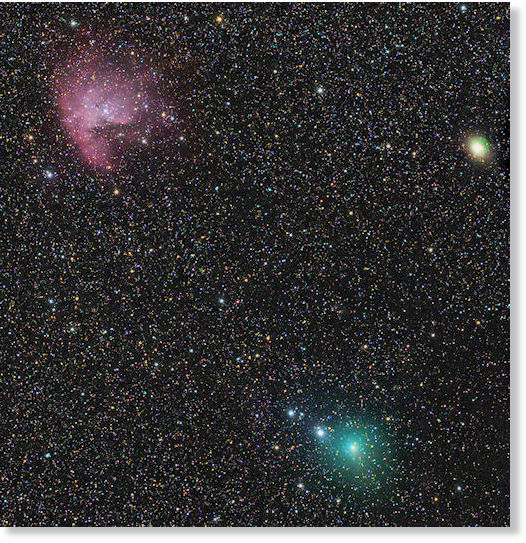
© Rolando Ligustri
Two weeks after Comet Hartley has its close encounter with Earth, NASA will have a close encounter with the comet. The EPOXI spacecraft (formerly known as Deep Impact) is hurtling toward Comet Hartley now, and on Nov. 4th it will fly 435 miles from the comet's active icy nucleus. The encounter will mark only the fifth time in history that a spacecraft has been close enough to image a comet's core.
Until then, amateur astronomers can monitor the comet as it glides through the constellation Cassiopeia in the evening sky. A finder chart from Sky and Telescope shows the comet passing by a variety of stars and deep-sky objects, offering many photo-ops in the nights ahead.
More images: from Dale Ireland of Silverdale, Washington; from Kevin Black of Winnipeg, Manitoba Canada; from Alan Dyer of near Cluny, Alberta, Canada
2:50:00 AM
Comet To Brighten in October
Comet Hartley 2 Seen in Cassiopeia
 In the image below, taken on the evening of Friday, Oct. 1, Comet Hartley 2 can be seen in the constellation Cassiopeia (north-east sky, not far from horizon)...more

| Posted on Oct 06, 2010 11:49:04 AM | William Cooke | |


2:39:00 AM
Early October SE U.S. Fireball
Fireball in the Sky!
It was brief, but it was brilliant! On Saturday, Oct. 2, 2010 at approximately 8:50 p.m. CDT, cameras operated by NASA's Meteoroid Environment Office at Marshall Space Flight Center in Huntsville, Ala., recorded a slow moving fireball moving from the north to the southwest...more
| Posted on Oct 04, 2010 04:34:27 PM | William Cooke |
2:28:00 AM
Bright SE U.S. Fireball 09/23/10
Bright September Meteor
Posted on Sep 23, 2010 10:06:10 AM | William Cooke |
Marshall Space Flight Center PAO Steve Roy was out jogging early Friday morning with his dogs, Lilly and Scout, when he couldn't help but notice this bright meteor low in the eastern sky...more
Posted on Sep 23, 2010 10:06:10 AM | William Cooke |
Marshall Space Flight Center PAO Steve Roy was out jogging early Friday morning with his dogs, Lilly and Scout, when he couldn't help but notice this bright meteor low in the eastern sky...more
8:14:00 PM
1:47:00 AM
ASTEROID Debris Strikes Earth in New Mexico? Sep 21, 2010
"Event 3" of 21SEP2010 03:03UTC 9:03pm MDT
Video by Sandia National Laboratories (c) 2010 All Rights Reserved
ASTEROID Debris Strikes Earth in New Mexico?
Multiple fireballs over New Mexico and Western Texas May be Linked to a Recent Asteroid Near Earth Event
by Jim Gamble and LunarMeteorite*Hunter
(c) 2010 AllRightsReserved Excerpts only with full URL and Author(s) citation.
Recent multiple fireballs reports streaming in from North and South America may be linked with the near Earth passing asteroids of Sep 8-9. The most recent multiple events occurred last night (Sep 21, 2010) over Texas, New Mexico, and Colorado. The first two of the multiple events were nearly simultanenous over central New Mexico. They were followed by Event 3, a 23 second major bolide event over northern New Mexico at 9:03pm MDT (03:03UTC)
(see LunarMeteorite*Hunters).
Event 4 occurred some one-and-a-half hours later at 10:36pm MDT (04:36UTC), and was also observed from El Paso, Texas. It was of short duration, approximately 1.5 seconds, with a visual magnitude of -6. It followed the identical trajectory of Events 1,2,3 but occurred farther south, probably over south central New Mexico.
video credit: Thomas Ashcraft Allsky Observatory (c) 2010 All Rights Reserved
Updates will be post as available. Comments/Contacts can be made at WXTX01@gmail.com
7:18:00 PM
CELESTRON ULTIMA 11 Telescope for Sale
TELESCOPE AND ACCESSORIES FOR SALECELESTRON ULTIMA 11, 11" SCT in excellent condition, seller is original owner... purchased in 1997 but has been in dry storage


Accessories Include:
- Original owner's manual.
- Heavy duty tripod with electronic wedge tracking mount with hand controller.
- 7x50 finder with illuminated crosshair reticle.
- 6X30 Celestron finder not attached
- 80mm Celestron guidscope with dual 120mm Losmandy dovetail mounting rings.
- Losmandy dovetail camera mount
- 2 inch star diagonal with 1.25 inch adapter.
- Telrad star finder.
- T-adapter (fits all Nikon digital camera mounts).
- Celestron visual back 1.25".
- 80mm Thousand Oaks Type II Solar Filter.
- Celestron radial guider.
- Counterweights included.
1.25 INCH EYEPIECES:
- 1-32mm Meade Plossl 1.25".
- 1-30mm Celestron Ultima 1.25".
- 1-26mm Celestron Plossl 1.25".
- 1-18mm Meade super wide angle 1.25".
- 1-12.4mm Meade super plossl 1.25".
- 1-4.8mm Nagler 1.25".
- 1-11mm Teleview plossl 1.25".
- 1-8mm Teleview plossl 1.25".
- 1-Celestron reducer/corrector f/6.3 1.25".
- 1-1.25" rubber eyepiece light guard.
- 1-12.5mm Celestron Micro Guide illuminated reticle 1.25".
- 1-9mm Meade plossl IR illuminated reticle 1.25".
- 1-Meade 2X tele-negative amplifier w/ air spaced triplet.
- 2 INCH EYEPICES:
- 1-9mm Teleview Nagler 2".
- 1-22mm Teleview Panoptic 2".
- 1-55mm Teleview plossl 2".
- 1-13mm Teleview Nagler 2".
FILTERS: (all are 1.25")
- 1-Meade 4000 series 0.9 Neutral Density.
- 1-OIII
- 1-Meade Nebular broadband
- 1-Meade #80-A
- 1-Meade #58
- 1-Meade #12
- 1-Meade #23-A
Price $3,500 o.b.o. Seller will deliver within 250 miles of El Paso, TX at no additional charge Email: wxtx01@gmail.com
12:49:00 AM
Bright El Paso, Texas Meteor 09/09/10
09/09/10...Bright meteor event over Western Texas...Southern New Mexico...Northern Mexico at 00:17:00 MDT (19:17:00 UTC) Any witnesses or all sky camera detections should post to this site please. Event was likely a -10+ lasting 2-3 seconds and likely traveling N to S or NE to SW. No sounds heard. If you observed this event, please post to comments below. Thank you.
Video taken by Thomas Ashcraft from Santa Fe, NM of the Sept. 9, 2010 meteor event.
Video taken by Thomas Ashcraft from Santa Fe, NM of the Sept. 9, 2010 meteor event.
11:05:00 PM
North Texas Fireball 09/05/10
Sept. 5th...two reports of a fireball over North Texas. One at 10:00:pm CDT from Flower Mound by Aidan Glynn...Another at 10:30pm CDT from Witchita Falls, Tx by Renee Brunovsky...Both reported to be of Magnitude -9 with colors of orange and red lasting 4 to 5 seconds with a persistent train. No sounds heard. If you saw this event, please comment below. Thank you.
3:40:00 PM
Washington Meteorite?
posted by LunarMeteorite*Hunter at Latest Worldwide Meteor/Meteorite News -
Did A *Meteorite* Smash Into A Monroe, WA Home? *Q13 FOX Seattle* Wed, 01 Sep 2010 22:26 PM PDT
A Monroe man thought his house came "under fire" but instead found what he beli...
6:36:00 PM
July 31, 2010 Eastern NM Fireball
There was a significant fireball over eastern New Mexico this morning that "turned night into day" as the saying goes. I am still processing the data but here is a preliminary movie with the audio of the radio head echo. The full radio reflection was over three minutes duration. (Of possible significance is the subtle "whizz" or whistle sound initially which may be direct meteor emission rather than forward scatter reflection.)
It is also possible this meteor was an SDA or alpha Cap or may trace back generally to that radiant region. Not sure about that though due to cloud cover.
It is also possible this meteor was an SDA or alpha Cap or may trace back generally to that radiant region. Not sure about that though due to cloud cover.
mp4 video: Thomas Ashcraft, New Mexico,
4:30:00 PM
Santa Fe N.M. Once Smashed By Ancient Meteorite
Mother Nature NetworkBy Katherine ButlerSat, Aug 21 2010 at 11:56 AM EST Comments A large meteorite smashed into what is now Santa Fe, New Mexico, some million or billion years ...
http://www.mnn.com/earth-matters/space/stories/santa-fe-once-destroyed-by-ancient-meteorite
9:17:00 PM
New Asteroid/Bolide Early Warning System
site) could allow astronomers to watch the entire sky for asteroids and bolides – meteors that hit Earth's atmosphere and explode. The telescopes would be arranged in pairs at ...(more)
10:41:00 PM
"Star Hustler" Jack Horkheimer Dies At 72
Saturday, August 21, 2010
Meteor/Meteorite News 21AUG2010
`Star Hustler' host Jack Horkheimer dies
By ELINOR J. BRECHER crline ebrecher@MiamiHerald.com
Jack Horkheimer, Public Television's ``Star Hustler,'' died Friday afternoon of a respiratory ailment, according to a spokesman for the Miami Museum of Science and Space Transit Planetarium.Born June 11, 1938, he was 72. ... [Read More]:
http://cs.astronomy.com/asycs/blogs/astronomy/2010/08/20/the-star-hustler-dies.aspx
1:13:00 AM
August 15, 2010 Central TX to Eastern NM Fireball
laura says:
August 16, 2010 at 9:54 pm
We saw a HUGE meteor, the largest I had ever seen at around midnight on Aug 15th over Texas. It took our breath away how vivid it was and you could see it break-up at it came falling down.
Reply
*
Ginger says:
August 17, 2010 at 12:22 pm
In Austin, Texas, on Sunday, August 15 at 1 am Central time, 2 friends and I saw a huge fireball race across a large portion of the northern sky. It finally broke into 4 pieces and then shattered into thousands of pieces. It was way bigger and brighter than any meteorite I’d ever seen before. We were all stunned!
8:49:00 PM
Latest El Paso, TX Meteor Event - May 26th, 2010 05:21:08hrs MDT (11:21:08 UTC)
 May 26th, 2010 at 05:21:08 hrs MDT, our ELP Sentinel Allsky Camera recorded a meteor event in our west-southwest sky. Visual magnitude calculated to be -10.4 (very bright "shadowcaster"). Detonation (terminal explosion) was detected.
Subscribe to:
Posts (Atom)